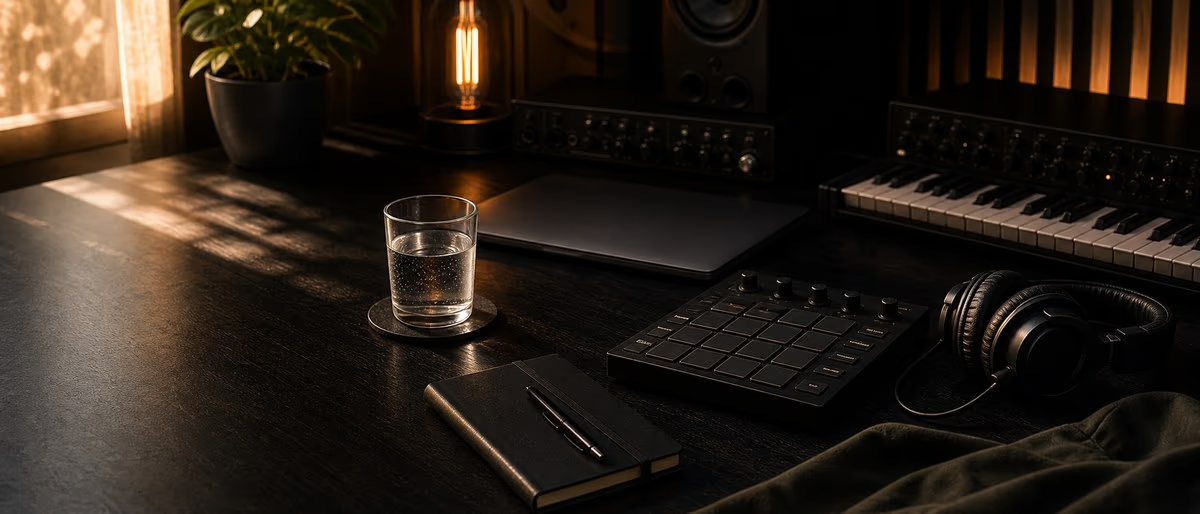
The Post-Production Nausea Phenomenon
Beatmakers experience a unique form of creative fatigue that guitarists, vocalists, and DJs rarely encounter. It is called post-production nausea — the psychological rejection of your own work after hearing it on loop cho hours.
When you build a beat, you hear the same 8-bar loop 200-400 times in a single session. Your brain adapts through a process called neural habituation — the same mechanism that makes you stop noticing a clock ticking after five minutes. The problem: habituation does not discriminate between annoying sounds and creative work. Your brain literally stops responding to your own beat as if it were background noise.
The Neuroscience of Auditory Fatigue
Your auditory cortex processes sound by identifying patterns and predicting what comes next. When a loop repeats predictably, the cortex reduces activation — it delegates the task to lower-level processing and stops engaging higher creative circuits.
This is why your beat sounded incredible at bar 16 and boring at bar 200. The music did not change — your brain stopped paying attention. Research on repetitive sound exposure shows that dopamine release in response to music drops by 40-60% after the 50th repetition. For beatmaker, this happens in under an hour. The result: you start second-guessing every choice, adding unnecessary layers, or abandoning the project entirely.
Exercise: The 48-Hour Detox
The 48-hour detox is a hard rule: after any session longer than 90 minutes, you are forbidden from listening to that project cho two full days.
This is not a suggestion — it is a protocol. Export a rough bounce, name it clearly, close the project, and do not reopen it. The 48-hour window allows neural habituation to reset. When you return, your brain processes the beat as fresh input, not background noise. Most producer report that 70% of their perceived problems disappear after the detox. The remaining 30% are real issues worth fixing.
Technique: The Blind Drop
Visual feedback from your DAW creates a second layer of fatigue. You start making decisions based on what looks right on the piano roll rather than what sounds right.
The blind drop removes visual bias. Close your eyes or turn off your monitor. Set a 15-minute timer and build an 8-bar section using only your ears. Do not look at waveforms, meters, or the arrangement view. Force your auditory cortex to do all the work. This technique reactivates the neural circuits that habituation has shut down. Producer who use the blind drop report higher satisfaction with their work and fewer unnecessary revisions.
Practice: Fresh Ears Exchange
Your ears are the worst judge of your own unfinished work. You know what you intended, so you hear intention instead of reality.
Find one other producer you trust. Exchange unmixed, unmastered 16-bar loops every week. Each person writes three sentences of feedback: what works, what confuses, what they would change. This is not collaboration — it is diagnostic. Fresh ears catch problems you have habituated to and validate strengths you have stopped hearing. The exchange also creates accountability: knowing someone else will listen keeps you from abandoning projects prematurely.
Chronic Burnout vs. Normal Fatigue: Cách Tell the Difference
Not all creative fatigue is burnout. Understanding the difference prevents you from taking unnecessary breaks or, worse, pushing through real burnout.
Normal fatigue resolves with sleep, a day off, or switching projects. You still feel curiosity about music. Chronic burnout persists cho weeks. You dread opening your DAW. Listening to music — any music — feels like work. You experience physical symptoms: tension headaches, jaw clenching, or insomnia after sessions. If you have three or more chronic symptoms, stop producing cho 7-14 days. Not a reduced schedule — a full stop. Burnout is an injury, not a mood.
When to Pause, When to Switch, When to Push Through
The hardest decision in production is knowing whether a project needs more time, a different approach, or abandonment.
Pause when you have spent more than 3 hours on a single 8-bar section without meaningful progress. Export and walk away. Switch when you have tried three different approaches to the same problem and none feel right. Start a new beat with a different tempo, key, or sample source. Push through only when you have a clear vision and the obstacle is technical — a sound you cannot quite get, a mix element that needs adjustment. Never push through when the obstacle is emotional. Emotional resistance is data, not weakness.
Normal Fatigue vs. Chronic Burnout
| Symptom | Normal Fatigue | Chronic Burnout |
|---|---|---|
| Duration | 1-2 days | 2+ weeks |
| Interest in music | Reduced cho one project | Reduced cho all music |
| Physical symptoms | Mild eye strain | Headaches, insomnia, tension |
| Recovery method | Sleep, day off | Extended break, lifestyle change |
| DAW response | Feels slow | Feels actively stressful |
| Creative curiosity | Returns quickly | Feels foreign or distant |
Burnout Recovery Protocol: 5 Steps
- Export and name every active project: 1 Create a folder called _detox. Export rough bounces of every project you have worked on in the last 30 days. Name them with date and genre. Close all DAW projects.
- Schedule a 48-hour listening ban: 2 Set a phone reminder. No listening to your own work cho 48 hours. You can listen to other music, but nothing you produced.
- Do one blind drop session: 3 Turn off your monitor. Set a 15-minute timer. Build something new with your eyes closed. Do not save unless you genuinely like it.
- Set up a fresh ears exchange: 4 Message one producer. Propose a weekly 16-bar loop exchange with three-sentence feedback. Set a recurring calendar event.
- Audit your physical setup: 5 Check monitor height, chair position, and lighting. Poor ergonomics amplify mental fatigue. Fix one physical issue before your next session.
Learning path
Related answer hubs
article.relatedPostsTitle
![Singing Success 360 The Complete Method (SS360) [TUTORiAL]](/images/posts/singing-success-360-the-complete-method-ss360-84348-326w.avif?v=20260630)
Singing Success 360 The Complete Method (SS360) [TUTORiAL]
![On Point Samples The Industrial Rawstyle Kick System [WAV, Synth Presets, TUTORiAL, DAW Templates]](/images/posts/on-point-samples-the-industrial-rawstyle-kick-system-84280-326w.avif?v=20260630)
On Point Samples The Industrial Rawstyle Kick System [WAV, Synth Presets, TUTORiAL, DAW Templates]
![FaderPro The One Hour Mixing Workflow [TUTORiAL]](/images/posts/faderpro-the-one-hour-mixing-workflow-84119-326w.avif?v=20260630)
![Udemy Learn Piano The Easy Way A Beginner's Guide [TUTORiAL]](/images/posts/udemy-learn-piano-the-easy-way-a-beginners-guide-84213-326w.avif?v=20260630)
Udemy Learn Piano The Easy Way A Beginner's Guide [TUTORiAL]
![Truefire Polyrhythm and Advanced Rhythm Training (JamPlay) [TUTORiAL]](/images/posts/truefire-polyrhythm-and-advanced-rhythm-training-jamplay-84170-326w.avif?v=20260630)
Truefire Polyrhythm and Advanced Rhythm Training (JamPlay) [TUTORiAL]
![Udemy Piano for The Soul Canon in D for Beginner [TUTORiAL]](/images/posts/udemy-piano-for-the-soul-canon-in-d-for-beginner-84201-326w.avif?v=20260630)
Udemy Piano for The Soul Canon in D for Beginner [TUTORiAL]
Need fresh sounds to break the loop? Browse free sample packs and reset your inspiration.
Tải miễn phíを見るBurnout Recovery: Common Questions
- Vì sao do my beats sound worse the longer I work on them?
- This is neural habituation at work. Your brain reduces activation in response to repeated patterns. The beat has not changed — your perception has. The 48-hour detox resets this effect.
- How long should I take a break from producing?
- Normal fatigue: 1-2 days. Early burnout signs: 3-5 days. Chronic burnout: 7-14 days minimum. If symptoms persist after 14 days, consider whether music production is the right priority in your current life season.
- Can I work on multiple beats to avoid burnout?
- Yes, but with limits. Switching between 2-3 projects can prevent single-project fatigue. However, having 20+ unfinished projects creates decision paralysis, which produces its own form of burnout. Cap active projects at 3.
- Does listening to my own beats on different speakers help?
- Partially. Different speakers reveal new information, but they do not reset neural habituation. The 48-hour detox is more effective than speaker switching because it targets the brain, not the playback system.
- Is burnout a sign I should quit producing?
- No. Burnout is a sign your workflow needs restructuring, not that your passion is fake. Every professional producer experiences burnout. The difference is that professionals have recovery protocols. Amateurs interpret burnout as a character flaw.